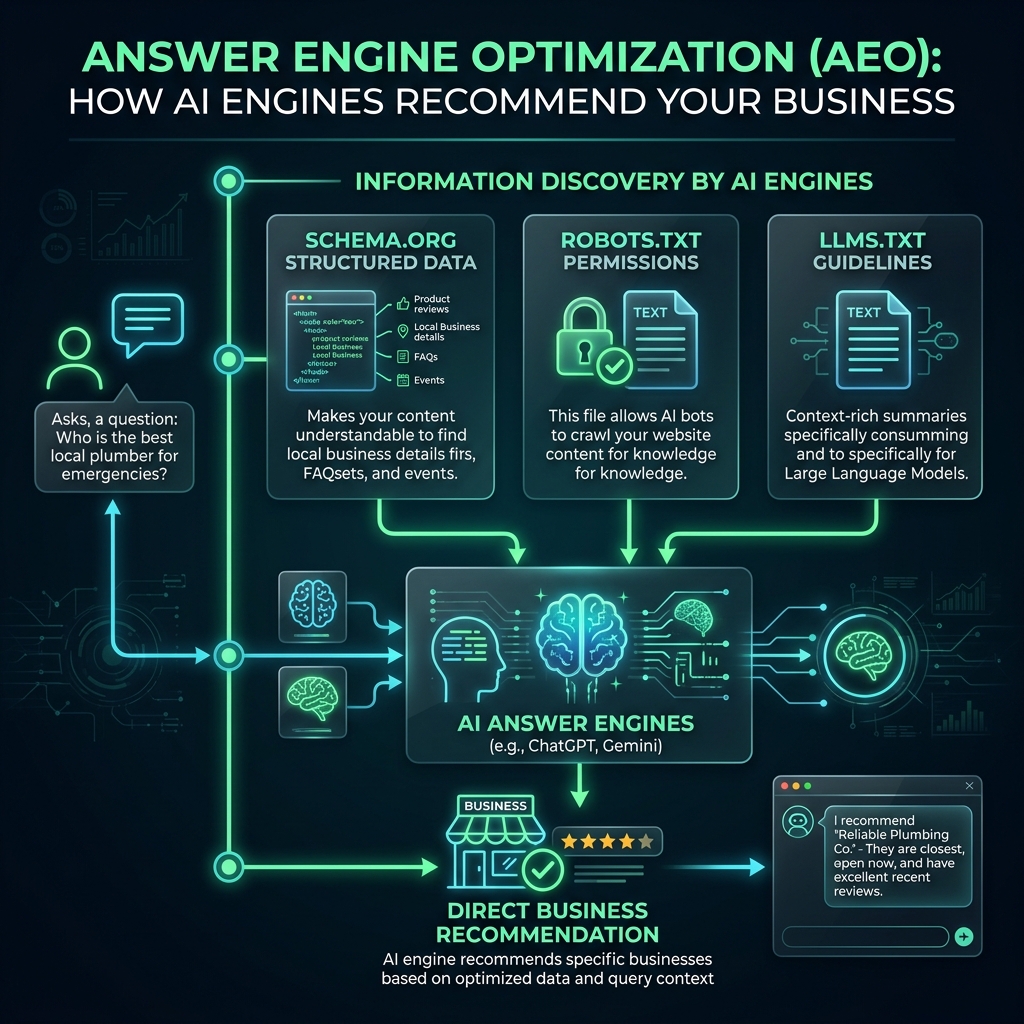
Your customers no longer only type into Google and click blue links. They ask ChatGPT, Gemini or the assistant on their phone directly:
"Recommend a reliable car inspection company in Bursa that is open on Saturdays."
The answer usually names one to five businesses. A business that is not on that list does not exist for that customer. AEO is the work of getting onto that list and being described correctly there. This guide covers what that depends on, what it does not depend on, and how to measure your own position. Every claim is backed either by our own measurement or by research with a named source.
AEO vs SEO vs GEO
- SEO: ranking high in Google's search results and earning the click.
- AEO: being named inside the answer an AI gives. Often the user never clicks through; they decide from the answer.
- GEO (Generative Engine Optimization): another name for the same work. The industry uses both terms interchangeably.
SEO is not dead: Google's AI Overviews are fed by Google's own index. A solid SEO foundation is the ground AEO stands on, but on its own it is not enough.
How does AI choose a business? Three layers
1. Permission: can the crawler get in?
AI companies' crawlers (GPTBot, ClaudeBot, PerplexityBot, Google-Extended…) check your site's /robots.txt. If it says Disallow: / for them, they do not take your content. The problem is not your content but the permission, and most businesses do not know about it.
Our measurement (September 2026): the website of a car inspection company we audited in Bursa, Türkiye, was well built, but its robots.txt blocked eight AI crawlers: GPTBot, ClaudeBot, Google-Extended, meta-externalagent, Applebot-Extended, CCBot, Amazonbot and Bytespider. Nobody had written those lines by hand. All of them sat inside a # BEGIN Cloudflare Managed content block: the "block AI bots" switch in the Cloudflare dashboard was on.
This is not an isolated case. Since July 2025, Cloudflare has been offering to block AI crawlers when a new site is onboarded, and its managed robots.txt writes those lines into your file for you. If you or your agency put your site behind Cloudflare, check whether that switch is on.
Without exaggerating: this block does not cover Googlebot, so your classic Google rankings are not affected. Blocking Google-Extended affects Gemini but not Google's AI Overviews (those are fed by the Googlebot index). ChatGPT's search side arrives as OAI-SearchBot and ChatGPT-User, which were not on that list. So the impact is real but partial. It is still the most commonly missed item, and it takes 30 seconds to check.
2. Readability: is the answer on the page as visible text?
When an AI fetches a page live, it reads the text shown on screen. In searchVIU's October 2025 test, ChatGPT, Claude, Perplexity, Gemini and Google AI Mode were given a product page to read. For the product whose price existed only in JSON-LD schema, none of them found the price. Hidden Microdata and RDFa were not read either.
In practice: if the information your customer asks about is not written on the page as plain text, the machine cannot quote it. Address, opening hours, service area, what the price depends on, cancellation terms, who you are not a fit for… It is not enough for these to live inside an image, a PDF or only in code.
For the same reason, sites that load their content only through JavaScript (where the page source contains little more than <div id="app"></div>) are at high risk: Googlebot runs JavaScript, but AI engines do not always run it when they fetch a page live.
3. Authority: do others confirm you?
Permission and text let the machine recognize you. For it to recommend you, it needs other sources: your Google Business Profile and its reviews, industry directories, news, comparison articles, forums.
Our measurement (September 2026): for a medical supply company in Bursa, we asked 12 real buyer questions in three engines (Perplexity, Gemini, ChatGPT). Across 36 attempts the company was recommended only twice. But when asked questions that named the brand, such as "is X reliable" or "where is X and when is it open", all three engines gave correct and positive answers.
So the machine knew the company, but recommended it to no one. The problem was not a bad reputation; the reputation was not reaching the machine. In the same audit we saw Gemini confuse the company with other businesses with similar names and attribute their complaints to it. The cause: an HTTPS error on the site meant the engines could not get to the source and verify it. An access error creates an identity problem.
What schema markup does, and what it does not
Schema markup (JSON-LD) is a technical requirement for Google's rich results: product cards, prices, review stars, FAQ dropdowns. That makes it valuable, and it should be set up.
But it is not a requirement for AI citations. In May 2026, Ahrefs compared 1,885 pages that added JSON-LD between August 2025 and March 2026 against 4,000 similar pages. In the 30 days after schema was added, the change in ChatGPT and Google AI Mode citations was statistically indistinguishable from zero, and AI Overviews saw a slight decline.
An honest caveat: these tests measure the moment an AI fetches a page live. Whether schema has an indirect effect during indexing or model training was not tested. So the accurate statement is not "schema is useless" but this: the claim that "without schema, ChatGPT cannot cite you" is false. If someone sells you schema as the key to AI visibility, ask for their source.
Do you need llms.txt?
llms.txt is a proposed file for offering an AI a Markdown summary of your site. It is cheap and harmless to add, and we use one ourselves. But set expectations correctly: as of 2026, none of OpenAI, Anthropic, Google or Perplexity has officially committed to reading it for search answers, and Google has said it does not support it. Prioritize robots.txt permission and visible on-page text.
Measure your own position in 15 minutes
- Permission: open
yoursite.com/robots.txtin a browser. Is there aDisallow: /line mentioning GPTBot, ClaudeBot, Google-Extended or PerplexityBot? Is there a# BEGIN Cloudflare Managed contentblock? - Question list: write down the 10–15 questions your customers ask most often on WhatsApp and the phone. Phrase them without your brand name, using the service and the city (e.g. "companies that build B2B websites in Uşak").
- Three engines: ask each question in ChatGPT, Gemini and Perplexity. For each answer, note: are you mentioned, what is said (correct, incomplete, outdated), who is recommended instead, which source is cited?
- Brand check: ask the same engines "is [your company] reliable, where is it, when is it open". If the answers are correct but you are missing from generic questions, your problem is not being recognized but being recommended: the authority layer.
- Record with dates: answers change. Save screenshots with dates and repeat the same questions 4–6 weeks later.
This method measures the outcome itself, not a proxy such as "is there schema". Put into a table, it leaves no room for argument: every row shows the name of the competitor recommended in your place.
AEO is not advertising
There is no panel where you can pay an AI to recommend you. The only currency is verifiable information: your real address and hours, a clear pricing logic, real customer reviews, what other sites write about you. That is why AEO is not a one-time setup but a process you measure and correct.
Frequently Asked Questions
Will AEO replace SEO?
No. Google's AI Overviews are fed by the Google index, and AI engines prefer pages that are accessible, fast and clearly written when they cite sources. A good SEO foundation is the ground for AEO; AEO adds the permission, readability and authority layers on top.
If I add schema, will ChatGPT recommend me?
Not on its own. In Ahrefs' 1,885-page study, adding schema did not meaningfully change AI citations. Set up schema for Google's rich results; for AI visibility, fix your robots.txt permission and the visible text on your pages.
How long until results show?
A permission fix (robots.txt) takes a day, but engines may take weeks to recrawl your site. The authority layer (reviews, external sources) builds over months. That is why it matters to record a dated baseline and repeat it 4–6 weeks later.
Which businesses does this matter for?
Any business whose customers ask "recommend me a company": clinics, real estate, tourism, car inspection, dealerships, B2B suppliers. Especially in sectors with high value per lead and many competitors, one name in the answer is a customer you directly lose.
What does AI say about you? Let's measure first.
Our AI Visibility work starts with a dated measurement using your sector's real buyer questions across three engines: where your name appears, who is recommended in your place, and whether the cause is permission, text or authority.
💬 Talk to Fatih Sağcan →